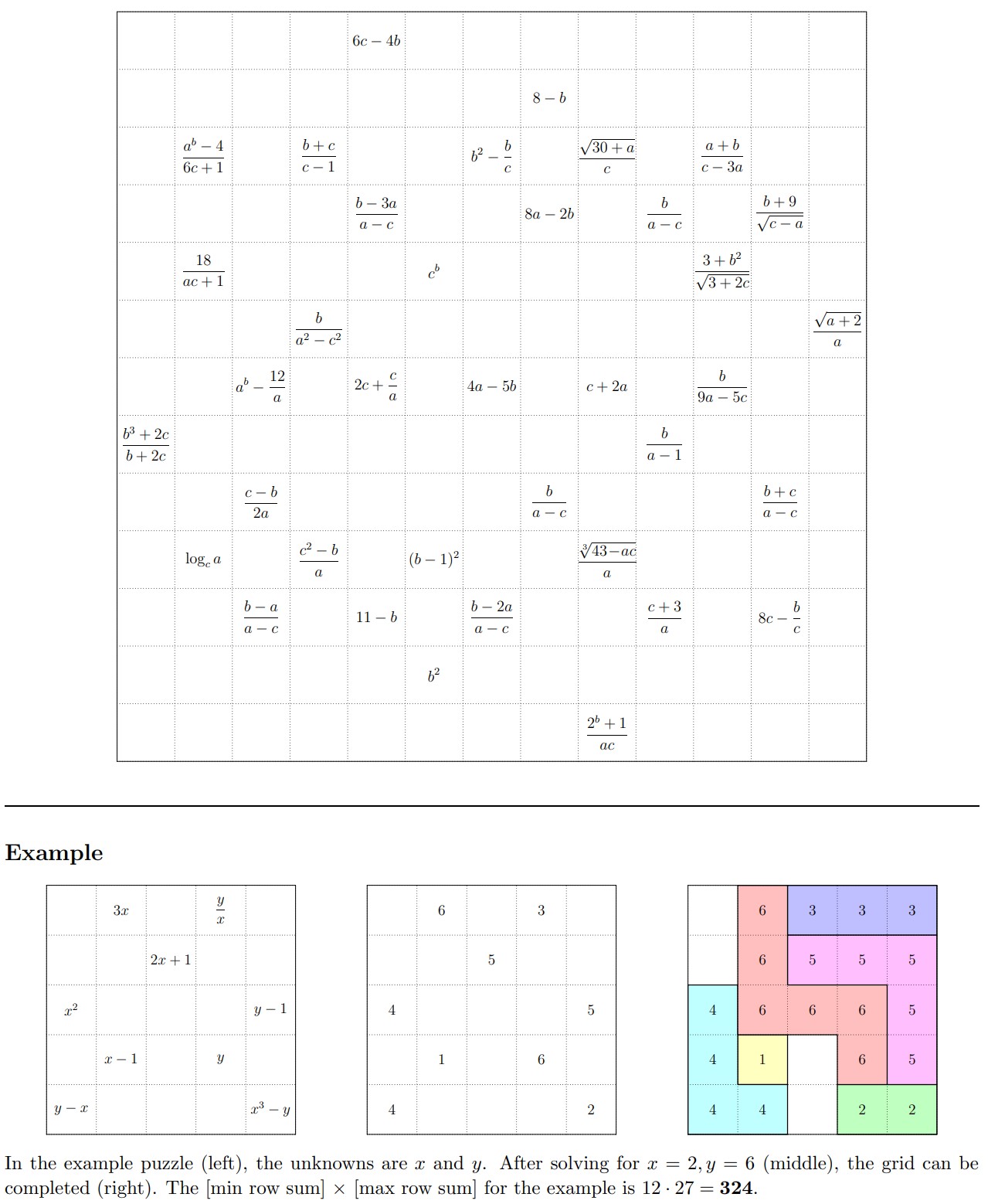
This month's puzzle is straightforward in comparison to January's puzzle. The first thing to find was the upper bound of the K K K 13 × 13 13\times 13 13 × 13 K K K 17 17 17
max K = 17 K=17 K = 17 17 ⋅ ( 17 + 1 ) 2 = 153 ≤ 169 \frac{17\cdot (17+1)}{2} = 153\leq 169 2 17 ⋅ ( 17 + 1 ) = 153 ≤ 169
This is only an upper bound value. Therefore, each equation must yield an answer between 1 1 1 17 17 17
b 2 ∈ { 1 , . . . , 17 } b^2\in \{1,...,17\} b 2 ∈ { 1 , ... , 17 } ( b − 1 ) 2 ∈ { 1 , . . . , 17 } (b-1)^2\in \{1,...,17\} ( b − 1 ) 2 ∈ { 1 , ... , 17 } b 2 = n b^2=n b 2 = n ( b − 1 ) 2 = m (b-1)^2=m ( b − 1 ) 2 = m
b 2 − ( b − 1 ) 2 = 2 b − 1 = m − n b^2-(b-1)^2=2b-1=m-n b 2 − ( b − 1 ) 2 = 2 b − 1 = m − n b = m − n + 1 2 = ± m b=\frac{m-n+1}{2}=\pm m b = 2 m − n + 1 = ± m This forces m m m b b b
b 2 ≤ 16 b^2\leq 16 b 2 ≤ 16 b ∈ { − 4 , − 3 , − 2 , − 1 , 1 , 2 , 3 , 4 } b \in \{-4,-3,-2,-1,1,2,3,4\} b ∈ { − 4 , − 3 , − 2 , − 1 , 1 , 2 , 3 , 4 } ( b − 1 ) 2 ≥ 1 (b-1)^2 \geq 1 ( b − 1 ) 2 ≥ 1 b ≠ 1 b\neq 1 b = 1 ( b − 1 ) 2 ≤ 16 → ∣ b − 1 ∣ ≤ 4 (b-1)^2 \leq 16 \rightarrow |b-1|\leq 4 ( b − 1 ) 2 ≤ 16 → ∣ b − 1∣ ≤ 4 b ∈ { − 3 , . . .5 } b\in \{-3,...5\} b ∈ { − 3 , ...5 } Thus b ∈ { − 3 , − 2 , − 1 , 2 , 3 , 4 } b\in \{-3,-2,-1,2,3,4\} b ∈ { − 3 , − 2 , − 1 , 2 , 3 , 4 }
Given that a + 2 a ∈ Z \frac{\sqrt{a+2}}{a}\in \mathbb{Z} a a + 2 ∈ Z a + 2 a ∈ { 1 , 2 , . . . , 17 } \frac{\sqrt{a+2}}{a} \in \{1,2,...,17\} a a + 2 ∈ { 1 , 2 , ... , 17 }
a + 2 = a k → a + 2 = a 2 k 2 \sqrt{a+2} = ak \rightarrow a+2 =a^2k^2 a + 2 = ak → a + 2 = a 2 k 2 a 2 k 2 − a − 2 = 0 a^2k^2-a-2=0 a 2 k 2 − a − 2 = 0 a = 1 ± 1 + 8 k 2 2 k 2 a = \frac{1\pm \sqrt{1+8k^2}}{2k^2} a = 2 k 2 1 ± 1 + 8 k 2 1 + 8 k 2 1+8k^2 1 + 8 k 2 a a a Checking values 1 1 1 17 17 17 k k k k = 1 , 6 k=1,6 k = 1 , 6 a = 2 a=2 a = 2 1 4 \frac{1}{4} 4 1
This narrows the search space a lot
We need c > a c > a c > a c − a \sqrt{c-a} c − a
We also need log c ( a ) \log_c(a) log c ( a ) n n n a = c n a = c^n a = c n
If a = 2 a = 2 a = 2 c n = 2 c^n = 2 c n = 2 c > 2 c > 2 c > 2
But c > 2 c > 2 c > 2 n ≥ 1 n \geq 1 n ≥ 1 c n > 2 c^n > 2 c n > 2 c n = 2 c^n = 2 c n = 2
Therefore a = 2 a = 2 a = 2
a = 1 4 a = \frac{1}{4} a = 4 1
The expression 4 a − 5 b 4a - 5b 4 a − 5 b
Substituting a = 1 4 a = \frac{1}{4} a = 4 1 4 ⋅ 1 4 − 5 b = 1 − 5 b 4\cdot\frac{1}{4} - 5b = 1 - 5b 4 ⋅ 4 1 − 5 b = 1 − 5 b
For this to land in { 1 , . . . , 17 } \{1,...,17\} { 1 , ... , 17 } b ≤ 0 b \leq 0 b ≤ 0
This eliminates b ∈ { 2 , 3 , 4 } b \in \{2, 3, 4\} b ∈ { 2 , 3 , 4 }
b ∈ { − 3 , − 2 , − 1 } b \in \{-3, -2, -1\} b ∈ { − 3 , − 2 , − 1 }
The expression c + 2 a = c + 1 2 c + 2a = c + \frac{1}{2} c + 2 a = c + 2 1 m m m
c = m − 1 2 c = m - \frac{1}{2} c = m − 2 1 m ∈ { 1 , 2 , . . . , 17 } m \in \{1, 2, ..., 17\} m ∈ { 1 , 2 , ... , 17 }
The constraint c > a = 1 4 c > a = \frac{1}{4} c > a = 4 1 m ≥ 1 m \geq 1 m ≥ 1
c ≠ 1 c \neq 1 c = 1 m ≠ 3 2 m \neq \frac{3}{2} m = 2 3 m m m So c ∈ { 1 2 , 3 2 , 5 2 , . . . } c \in \{\frac{1}{2}, \frac{3}{2}, \frac{5}{2}, ...\} c ∈ { 2 1 , 2 3 , 2 5 , ... }
c b = c − 1 = 1 c c^b = c^{-1} = \frac{1}{c} c b = c − 1 = c 1 c = 1 j c = \frac{1}{j} c = j 1 j j j From above, c = m − 1 2 c = m - \frac{1}{2} c = m − 2 1 1 j = m − 1 2 \frac{1}{j} = m - \frac{1}{2} j 1 = m − 2 1
The only solution with m m m j j j m = 1 , j = 2 m = 1, j = 2 m = 1 , j = 2 c = 1 2 c = \frac{1}{2} c = 2 1
( b + c ) / ( c − 1 ) = ( − 1 + 1 2 ) / ( 1 2 − 1 ) = ( − 1 2 ) / ( − 1 2 ) = 1 (b+c)/(c-1) = (-1 + \frac{1}{2})/(\frac{1}{2} - 1) = (-\frac{1}{2})/(-\frac{1}{2}) = 1 ( b + c ) / ( c − 1 ) = ( − 1 + 2 1 ) / ( 2 1 − 1 ) = ( − 2 1 ) / ( − 2 1 ) = 1 b 2 − b / c = 1 − ( − 1 ) / ( 1 2 ) = 1 + 2 = 3 b^2 - b/c = 1 - (-1)/(\frac{1}{2}) = 1 + 2 = 3 b 2 − b / c = 1 − ( − 1 ) / ( 2 1 ) = 1 + 2 = 3 ( b + 9 ) / c − a = 8 / 1 4 = 8 / 1 2 = 16 (b+9)/\sqrt{c-a} = 8/\sqrt{\frac{1}{4}} = 8/\frac{1}{2} = 16 ( b + 9 ) / c − a = 8/ 4 1 = 8/ 2 1 = 16 ( a b − 4 ) / ( 6 c + 1 ) = ( 4 − 4 ) / 4 = 0 (a^b - 4)/(6c+1) = (4 - 4)/4 = 0 ( a b − 4 ) / ( 6 c + 1 ) = ( 4 − 4 ) /4 = 0 The expression ( a b − 4 ) / ( 6 c + 1 ) = 0 (a^b-4)/(6c+1) = 0 ( a b − 4 ) / ( 6 c + 1 ) = 0 b = − 1 b = -1 b = − 1
c b = c − 2 = 1 c 2 c^b = c^{-2} = \frac{1}{c^2} c b = c − 2 = c 2 1 c 2 = 1 j c^2 = \frac{1}{j} c 2 = j 1 c = 1 j c = \frac{1}{\sqrt{j}} c = j 1 Combined with c = m − 1 2 c = m - \frac{1}{2} c = m − 2 1 m − 1 2 = 1 j m - \frac{1}{2} = \frac{1}{\sqrt{j}} m − 2 1 = j 1
For m = 1 m = 1 m = 1 1 j = 1 2 \frac{1}{\sqrt{j}} = \frac{1}{2} j 1 = 2 1 j = 4 j = 4 j = 4 c = 1 2 c = \frac{1}{2} c = 2 1
( a b − 4 ) / ( 6 c + 1 ) = ( ( 1 4 ) − 2 − 4 ) / ( 3 + 1 ) = ( 16 − 4 ) / 4 = 3 (a^b - 4)/(6c+1) = (({\frac{1}{4}})^{-2} - 4)/(3+1) = (16-4)/4 = 3 ( a b − 4 ) / ( 6 c + 1 ) = (( 4 1 ) − 2 − 4 ) / ( 3 + 1 ) = ( 16 − 4 ) /4 = 3 ( b 3 + 2 c ) / ( b + 2 c ) = ( − 8 + 1 ) / ( − 2 + 1 ) = − 7 / − 1 = 7 (b^3 + 2c)/(b+2c) = (-8 + 1)/(-2 + 1) = -7/-1 = 7 ( b 3 + 2 c ) / ( b + 2 c ) = ( − 8 + 1 ) / ( − 2 + 1 ) = − 7/ − 1 = 7 6 c − 4 b = 3 + 8 = 11 6c - 4b = 3 + 8 = 11 6 c − 4 b = 3 + 8 = 11 log c ( a ) = log 1 / 2 ( 1 / 4 ) = 2 \log_c(a) = \log_{1/2}(1/4) = 2 log c ( a ) = log 1/2 ( 1/4 ) = 2 b / ( a − 1 ) = − 2 / ( 1 / 4 − 1 ) = − 2 / ( − 3 / 4 ) = 8 / 3 b/(a-1) = -2/(1/4 - 1) = -2/(-3/4) = 8/3 b / ( a − 1 ) = − 2/ ( 1/4 − 1 ) = − 2/ ( − 3/4 ) = 8/3 The expression b / ( a − 1 ) = 8 3 ∉ Z b/(a-1) = \frac{8}{3} \notin \mathbb{Z} b / ( a − 1 ) = 3 8 ∈ / Z b = − 2 b = -2 b = − 2
With b = − 3 b = -3 b = − 3 a = 1 4 a = \frac{1}{4} a = 4 1 c b = c − 3 c^b = c^{-3} c b = c − 3 c = j − 1 / 3 c = j^{-1/3} c = j − 1/3 j j j
Combined with c = m − 1 2 c = m - \frac{1}{2} c = m − 2 1 m = 1 m = 1 m = 1 c = 1 2 c = \frac{1}{2} c = 2 1 c − 3 = 8 c^{-3} = 8 c − 3 = 8
Checking b / ( a − 1 ) = − 3 / ( 1 / 4 − 1 ) = − 3 / ( − 3 / 4 ) = 4 b/(a-1) = -3/(1/4 - 1) = -3/(-3/4) = 4 b / ( a − 1 ) = − 3/ ( 1/4 − 1 ) = − 3/ ( − 3/4 ) = 4
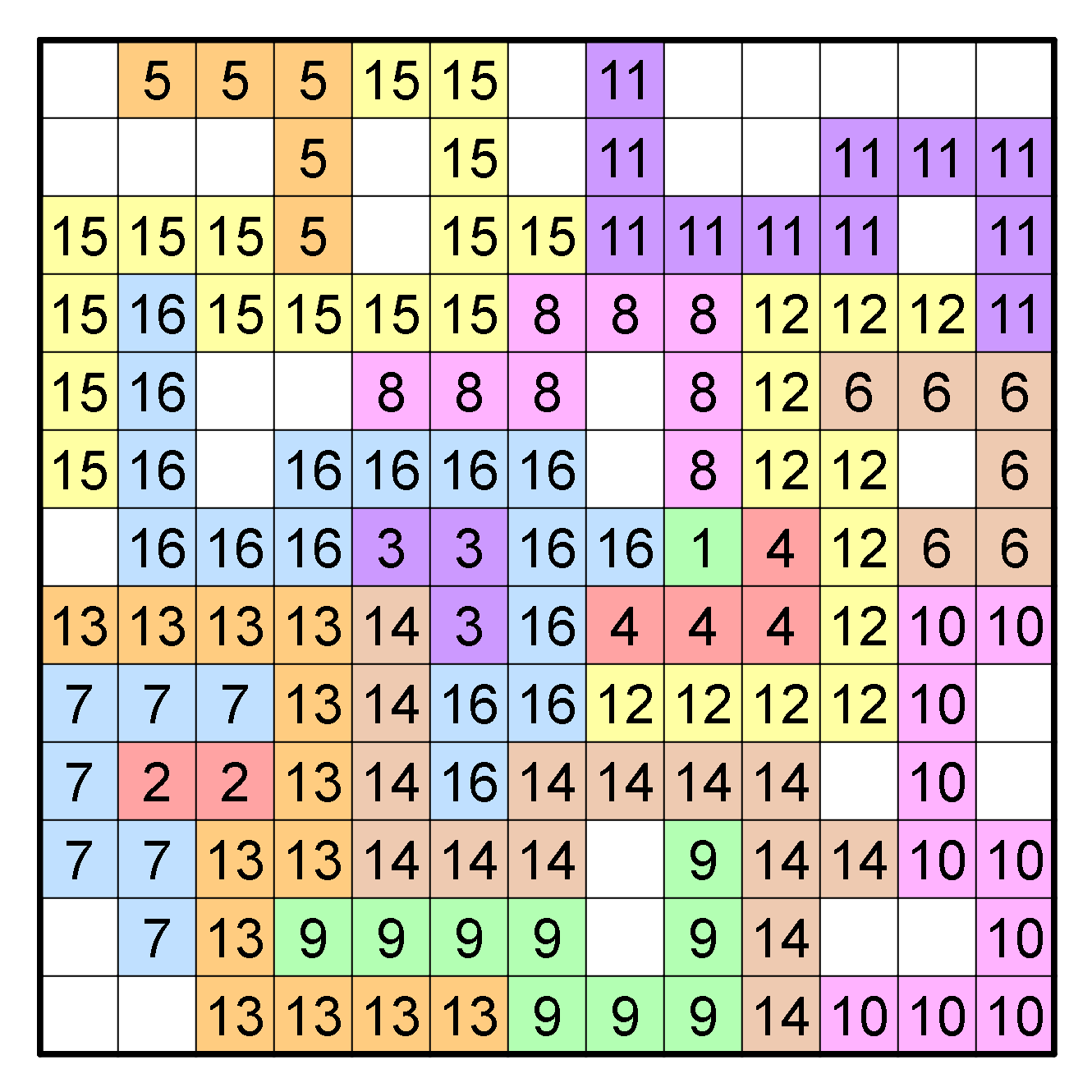
All 37 expressions now evaluate to positive integers:
a = 1 4 , b = − 3 , c = 1 2 \boxed{a = \tfrac{1}{4}, \quad b = -3, \quad c = \tfrac{1}{2}} a = 4 1 , b = − 3 , c = 2 1
Given that 12 12 12 k k k 12 12 12 k k k 9072 .
subtiles-ans.png